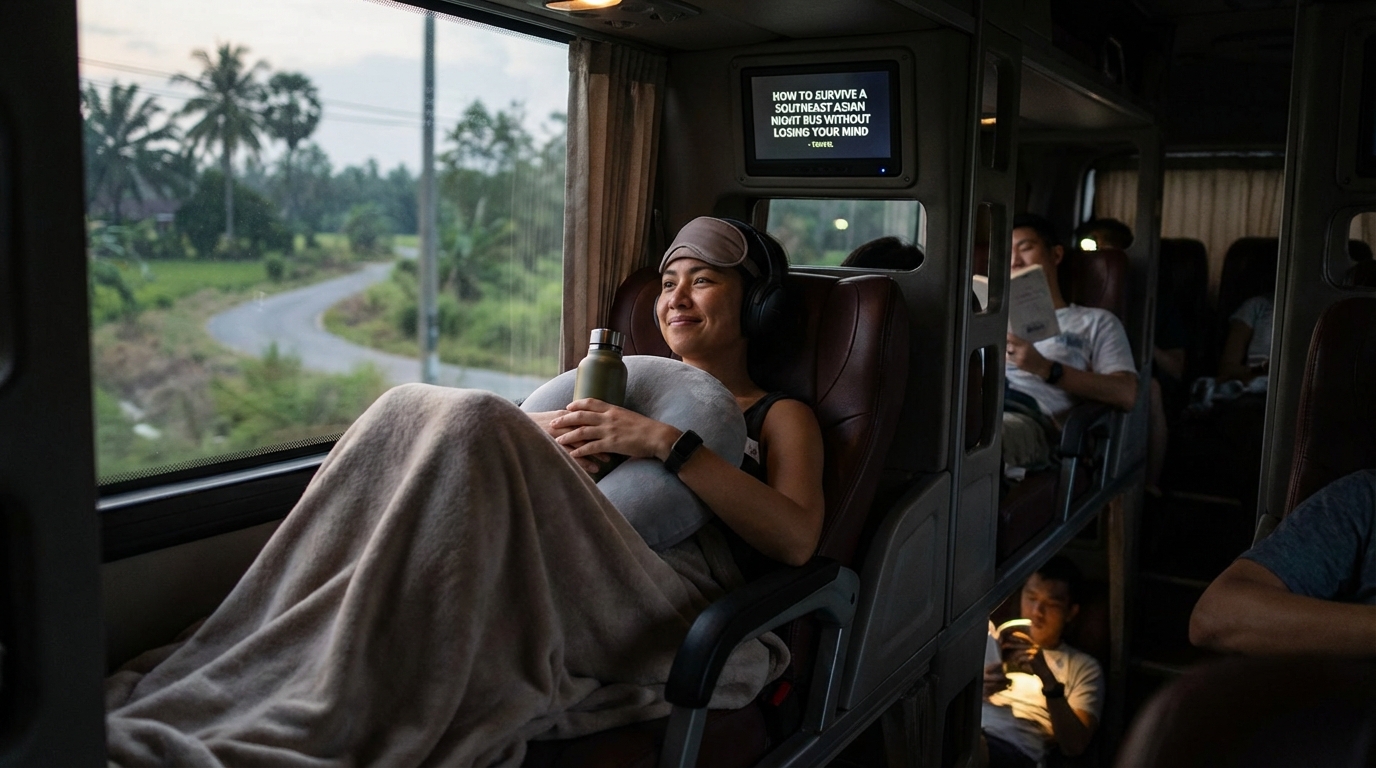
Imagine waking up at 3:00 AM in a vibrating plastic capsule, shivering under a tiny blanket while a loud pop song blares from the driver's cabin. If you are backpacking the region, taking a night bus in Southeast Asia is basically a rite of passage you can't avoid. It is the cheapest way to cross borders and see the sights, but without a solid plan, it can quickly turn into a long and sleepless ordeal.
Whether you are heading from Bangkok to Chiang Mai or crossing from Vietnam into Cambodia, these sleeper buses are a budget traveler's best friend. They save you the cost of a hotel and move you while you sleep, but they come with quirks like freezing air conditioning and beds that don't quite fit a human frame. You want to save your cash for street food, but you also want to arrive at your next stop feeling like a person rather than a zombie.
This guide covers everything you need to know to survive the ride with your sanity intact. We will look at how to snag the best bunk, what to pack in your bus bag, and how to handle the bathroom situation. By the time we are done, you will be ready to embrace the chaos and actually get some rest on the road.
The Wild World of Southeast Asian Night Buses
Stepping onto a night bus in Southeast Asia is a rite of passage for every budget traveler. It is the moment when the adventure feels real. You might be squeezed into a bunk, watching city lights blur past. Many travelers share these chaotic moments on video platforms, showing the bumpy roads and bright neon lights. It is a shared story with others trying to save money on a bed.
You will likely love and hate the trip at the same time. One minute you are happy about the price, and the next, you are awake at 3 AM in a random parking lot. This guide covers how to stay comfortable so you can survive the journey.
Key insights:
- The night bus is a dual experience of extreme convenience and minor discomfort.
- Modern travelers often document these rides as digital shorts to capture the unique atmosphere.
- Preparation is the difference between a sleepless night and a successful trip.
Is the Night Bus Actually Worth It?
Is the night bus actually worth the hassle? It is the age-old debate for anyone wandering through Southeast Asia. When you look at the numbers, the logic is hard to beat. You are essentially combining your transportation and your accommodation into one single ticket. That is one less night paying for a hostel, which adds up fast over a long trip. It is the kind of math that makes sense when you are stretching every cent. Beyond the wallet, think about your time. Taking a flight sounds fast, but once you add in the airport commute and the check-in lines, you have lost a whole afternoon. On a sleeper bus, you move while the sun is down. You go to sleep in one province and wake up in another. It is like time travel for the frugal. While you might miss the views, the scenic route is often better when you are asleep anyway. Interestingly, recent platform data shows that travelers now verify these routes by watching short-form videos. These clips, often found via Shorts URLs, provide a raw look at the bus interiors. Even as digital platforms update their terms into 2026, the basic need for a cheap way to get from A to B remains.
For the budget traveler, the night bus is a best friend. Every dollar saved on a bed is a dollar for more street food or a spontaneous boat tour. Most bus terminals are also much closer to the city center than airports. You avoid the expensive taxi rides from the outskirts and often land right where the action is. It is about keeping things simple and keeping your momentum high. By moving while you sleep, you maximize your daylight hours for exploring. It is a practical way to see the country without breaking the bank. You get to wake up refreshed or at least ready for coffee right in the heart of your next destination, ready to hit the ground running without a long commute.
But wait, before you book every leg of your trip on a bus, consider the physical toll. Some routes are notoriously rough with potholes or endless hairpin turns. If you have a big hike or a long day of sightseeing planned for the moment you arrive, a real bed might be worth the extra cost of a flight. Sometimes the time you save is lost anyway because you spend the next day napping to recover from a shaky ride. It is all about the trade-off between your budget and your energy. If the price difference is small and the road is long, just take the flight and save your sanity. The goal is to enjoy the trip, not just survive it.
Key insights:
- The night bus acts as a double-saver by covering both travel and a night of accommodation.
- Sleeper buses often arrive in city centers, saving you the high cost of airport transfers.
- Short-form video platforms like YouTube Shorts are becoming a primary way for travelers to vet bus quality.
- The physical cost of a poor night's sleep can sometimes outweigh the financial savings of a bus over a flight.
The Budget Traveler’s Best Friend
Ever tried to squeeze a long bus ride into your vacation? It feels like a waste. This is why the night bus is a win for anyone trekking through Southeast Asia. By sleeping while the wheels turn, you gain an extra day of exploring. You also save on a hostel bed. That extra cash goes straight into your street food budget.
Imagine waking up in Bangkok just as the markets open. Many travel secrets like this live on YouTube. While the technical side of the platform is just corporate links and copyright dates for 2026, the real value is the advice from fellow travelers. Being dropped in the city center means you skip the taxi and start your day where the action is.
When You Should Probably Just Fly Instead
Let’s be real: sometimes the adventure of a twenty-hour bus ride just isn’t worth the twenty bucks you are saving. If a route is known for winding mountain roads or endless delays, your sanity is worth the upgrade. Think about your plans for the next day. If you are starting a big hike or a sunrise tour, showing up like a zombie will not help.
The trade-off between time and money is a classic struggle. While travel videos on social media often make the experience look fun, the reality involves stiff necks and no legroom. Sometimes, the best move is checking flight prices. If a quick flight costs a little more than a grueling overnight haul, it is a small price for a real bed and a fresh start.
Key insights:
- Choose flying for mountainous routes where bus travel times are unpredictable.
- A real bed is essential if you have a physically demanding activity planned the next morning.
- Calculate the hourly cost of your discomfort before booking the cheapest option.
What to Expect When You Step Onboard
The moment you reach the bus door, the driver will hand you a plastic bag. This isn't for your trash. It is for your shoes. Walking onto a Southeast Asian sleeper bus in your socks feels strange at first, but you will soon appreciate the lack of street grime near your face. Once inside, you will see rows of bunk beds stacked two high. While booking sites often call these full-flat beds, the reality is usually a permanent 15-degree incline. It is a bit like trying to nap in a cat carrier. It is cozy for some, but a tight squeeze for most. You are essentially sharing a small metal tube with thirty strangers, and privacy is limited to a thin curtain that may or may not stay closed.
If you have been searching for advice on YouTube Shorts, you have likely seen the aesthetic version of this journey. But the standard corporate links for Google’s platform, like Press, Developers, and Safety, do not offer much help when you are actually on the road. Even with future-dated 2026 copyright tags in the footer of the site where you found your tips, the digital world feels far away when you are dealing with the smell of diesel. You are not just buying a ticket. You are signing up for a night of shared space and rhythmic engine vibrations. It is a rite of passage that every traveler needs to try at least once. Is it comfortable? Not exactly. But it is efficient, provided you can handle your personal space bubble shrinking for the next twelve hours.
You might board the bus in ninety-degree heat, but within twenty minutes, you will be convinced you have been locked in a walk-in freezer. For some reason, the default setting for bus AC in the tropics is Arctic Tundra. This is where that thin, scratchy blanket they provide becomes your best friend. It is not the softest fabric in the world, but it is the only thing standing between you and shivering all night. If the vent above your head will not close, try stuffing a spare sock into the slats. Much like a cat finding the one warm spot in a cold room, you will spend the night adjusting your position to stay out of the direct draft.
Then there is the bathroom mystery. Most sleeper buses have a tiny closet in the back that claims to be a toilet, but using it while the bus swerves around mountain curves is an Olympic-level challenge. Most veterans follow a strict hydration strategy. They stop drinking water an hour before boarding. You do not want to be that person begging the driver to stop on a dark highway. The real glory happens at the 2:00 AM roadside stop. You will be blinked awake by fluorescent lights and ushered into a massive concrete hall filled with steaming bowls of noodles and snacks. It is disorienting, loud, and weirdly wonderful. It is the perfect time to stretch your legs before curling back into your bunk.
Key insights:
- Do not trust the full-flat bed label because most have a permanent incline.
- The AC is extremely cold, so use the provided blanket or block the vents with a sock.
- Avoid drinking water before the trip to minimize the need for the onboard toilet.
- Roadside stops are the best chance to eat and stretch during the long journey.
The Arctic Air Conditioning Struggle
You step off a sticky sidewalk, sweating through your shirt, and climb onto the bus. Five minutes later, you are shivering. Why does every night bus in Southeast Asia feel like a walk-in freezer? It is a weird contrast, but that arctic blast is very real and lasts the entire trip.
This is where that thin, scratchy blanket becomes your best friend. Don't toss it aside because you will definitely need it by midnight. Also, check the vent above your head. If it will not twist shut, try blocking it with a hoodie or a spare sock. Stopping that icy jet from hitting your neck is the only way you will actually get some sleep. Think of it as a test of endurance before you finally reach the beach.
Key insights:
- Always keep your warm layers in your day pack rather than in the luggage hold.
- The AC vents are often broken, so having tape or a heavy shirt to block the air is a lifesaver.
The Bathroom Situation (Or Lack Thereof)
Let’s talk about that tiny door at the back of the bus. It’s a mystery wrapped in a bumpy ride, and honestly, you should save it for true emergencies. This is why strategic hydration is your best friend. If you chug a gallon of water before boarding, you're just asking for an awkward balancing act while the driver flies around mountain curves. Think of it as a survival game where the prize is staying in your seat.
The real hero of the trip is the 2:00 AM roadside stop. Even if you're groggy, get off the bus. There’s something magical about eating noodles under fluorescent lights while the rest of the world sleeps. It’s the perfect time to stretch and reset before the final stretch. While you might have watched travel shorts on YouTube to prepare, the actual experience of that midnight air is much better than any digital preview.
Key insights:
- Limit your water intake two hours before departure to avoid the onboard toilet.
- Always carry small change for the roadside stops since many rural stalls don't take cards.
- Use the 2:00 AM stop to move your legs and prevent the dreaded night bus stiffness.
Pro Tips for Snagging the Best Seat
Choosing between an upper or lower bunk is the first big decision you will face, and honestly, it is a bit of a toss-up. Lower bunks are great because you do not have to climb a ladder in the middle of the night, but the upper bunks usually feel less cramped and offer a bit more privacy from the aisle. Whatever you do, try to avoid the very back row at all costs. It is often called the 'danger zone' because you are sitting right on top of the engine and the rear axle. The heat and the constant vibration make it nearly impossible to settle in for a long haul. You will feel every single bump in the road like a personal attack.
The way we research these trips has changed completely. Instead of relying on outdated blog posts, many travelers now use social media infrastructure like YouTube Shorts to see real-time bus conditions. It is fascinating to see how digital platform governance works behind the scenes; some of these platforms already show copyright metadata dated for 2026, showing how fast their automated systems update. When you use these apps to check a bus layout, you are tapping into a massive corporate network designed to give you a preview of your journey. Modern booking platforms have finally caught up, offering interactive maps that let you click on your specific bed so you are not left guessing.
The golden rule for a smooth ride is simple: aim for the middle of the bus. This spot acts like a pivot point, staying much steadier than the seats directly over the wheel wells, which can be brutal on older roads. You should also stay at least three rows away from the bathroom door. The constant traffic, swinging door, and flickering lights make it a high-noise area that ruins any chance of rest. Before you finish your booking, always pull up the seat layout to verify your spot. If a site does not offer a clear map, it is usually worth switching to a different platform that does.
Key insights:
- Lower bunks offer better storage access while upper bunks provide more privacy.
- The middle of the bus is the most stable area for sleeping through bumpy road conditions.
- Avoid the back row to escape engine heat and excessive bouncing over the rear axle.
- Use modern booking platforms and video tours to verify the bus layout before paying.
The Golden Rule of Seat Selection
Picking your spot is the secret to actually getting some sleep. You should aim for the middle of the bus, like a cat finding the softest part of the sofa. Stay away from the wheel wells so you don't get bounced around. Also, avoid the seats right next to the bathroom. The smell and the constant sound of the door swinging shut will keep you awake.
Before you pay, check the seating chart. Many travelers use digital platforms and short-form videos to see the real layout of specific buses. It’s a simple step that saves you from being stuck in a cramped corner like a kitten in a carrier. These visual resources often show the real conditions that official booking sites might hide.
Key insights:
- The middle of the bus offers the most stable ride by avoiding the suspension bounce over the wheels.
- Using digital platforms to see real video layouts helps you avoid seats that don't recline or have limited legroom.
Your Essential Night Bus Survival Kit
You are standing on a dusty curb while your main backpack gets tossed into the dark luggage hold for the night. To stay sane, you need a small bus bag that stays right at your feet. This kit should have everything you need for the next twelve hours so you are not stuck begging the driver to stop. Many travelers use YouTube Shorts to find these packing tips before they head out. While you scroll for advice, you might notice the complex platform setup with links for things like press, creators, and developers. It is interesting that their legal footer and copyright info already point toward 2026, which shows just how much planning goes into the digital infrastructure we use to navigate the world.
A lightweight sarong is a total lifesaver for any long trip across the region. It is thin enough to fit in a tiny pocket but works as a warm blanket when the bus driver turns the air conditioning down to freezing levels. Think of the sarong as a multi-tool for your body since you can also roll it up to use as a pillow or hang it over your window to block out bright streetlights. Pair this with a good set of noise-canceling headphones to block out the loud karaoke or high-energy action movies that often play on the bus speakers. These headphones are not just a luxury; they are your best tool for creating a quiet sanctuary in a crowded moving vehicle.
When it comes to your tech, do all your downloading while you still have hotel Wi-Fi. Get your offline maps and a few podcasts ready because the signal will definitely drop out once you hit the mountain passes. A fully charged power bank is also a must because the USB ports on these buses are often broken or charge way too slowly. When you are finally ready to sleep, keep your phone somewhere very safe instead of leaving it on your lap. You might want to tuck it into a deep pocket or even inside your pillowcase. This keeps your expensive gear secure and gives you peace of mind while you catch some rest during the long haul.
Key insights:
- A dedicated bus bag prevents the stress of losing access to essentials in the cargo hold.
- Sarongs offer a versatile solution for temperature control and privacy in cramped quarters.
- Offline digital preparation is the only way to ensure entertainment and navigation work in remote areas.
- Securing tech physically to your person is vital for relaxing during sleep on public transport.
Tech and Entertainment
Ever tried finding your hostel at 3 AM with zero signal? It’s a nightmare. Before you lose service in the rural stretches of Vietnam or Thailand, download your offline maps and a stack of podcasts. While digital platforms like YouTube are already updating their technical frameworks for 2026, that code won't help you when you're stuck in a dead zone without a connection.
Your phone is your lifeline, so a beefy power bank is a total must-have. Just keep it secure. Instead of leaving it on the seat while you nap, tuck it into a zipped pocket or wrap the cord around your wrist. Why risk your gear? You want to wake up with your phone and your sanity intact.
Key insights:
- Offline maps are a safety essential for late-night arrivals in unfamiliar cities.
- Physical cord-wrapping acts as a simple, effective theft deterrent while you sleep.
Staying Safe and Secure on the Road
Imagine waking up at 4:00 AM on a dark border, feeling disoriented. This is when cross-border scams happen. In a town like Poipet, you might be told your bus is broken just to force a pricey taxi hire. It is a classic trap. Staying alert during these odd hours is your best defense against losing cash to a smooth talker.
The golden rule? Keep valuables on you, not in the luggage hold. Passports and wallets should stay in your lap, perhaps while you curl up for a nap like a tired kitten. Bags under the bus are too easy for others to reach. What does this mean for you? It means trusting your gut. If a driver looks exhausted or the station feels off, just walk away.
Many travelers find these tips through YouTube Shorts. While the platform provides links for How YouTube works or Safety policies, these are often just standard corporate pages. Even with Google LLC updating its metadata for 2026, tech cannot replace your own eyes. Research online, but keep your focus on the road.
Key insights:
- Keep your daypack physically attached to you during border crossings.
- Scams thrive on traveler fatigue, especially during pre-dawn transfers.
- A higher ticket price usually buys a more reliable, rested driver.
Common Questions About Overnight Bus Travel
You are likely standing at a dusty station in Bangkok or Hanoi, staring at a bus that looks like a neon-lit spaceship, wondering what you have gotten yourself into. Is it actually safe? Will you get any sleep? These are the questions that keep travelers up long before the engine even starts. It is completely normal to feel a knot in your stomach when you are about to hand over your bags and climb into a tiny bunk for a twelve-hour journey across a foreign country.
When looking for advice, many of us turn to YouTube, scrolling through Shorts to see what the seats actually look like. It is interesting to note that while we are searching for practical tips, the digital infrastructure behind those videos is managed by massive entities like Google LLC. Even as the platform metadata points toward future-dated copyright information for 2026 and standard corporate links for press and developers, the human element is what we really crave. We want to see a real person showing us the reality of a sleeper bus, not just the legal boilerplate of a social media site.
Booking usually happens through your hostel or a local site. You might wonder if you should pick a specific seat. Here is a tip: avoid the very back row unless you want to feel every single bump in the road. Also, keep your valuables in a small bag that stays literally attached to your body at all times. Most people worry about security, but if you are smart about your gear, you can relax. The reality is that these buses are the backbone of travel in the region.
Think of it this way: the night bus is a rite of passage. It saves you the cost of a hotel room and gets you to your next destination by sunrise. Is it perfect? Probably not. But once you realize that everyone else is just as tired and confused as you are, the stress starts to fade. You will survive, and you will have a great story to tell when you finally reach the beach.
Key insights:
- Digital platforms provide quick visual previews of travel conditions, even if the underlying site data is mostly corporate metadata.
- Strategic seat selection, like avoiding the back row, significantly improves the comfort of your journey.
- Keeping valuables physically attached to your person is the most effective way to handle safety concerns.
Ready for the Ride?
Is a night bus across Southeast Asia just a way to get from A to B? Not really. It is a rite of passage. You will find yourself squeezed into a tiny bunk, likely sharing a thin blanket with a stranger while the driver treats mountain roads like a racetrack. But here is the thing: there is a strange, beautiful camaraderie in those shared struggles. You are all in it together.
Even as digital platforms like YouTube update their features and safety rules for 2026, the raw energy of a sleeper bus remains refreshingly analog. You might see creators filming their journey for a Shorts video, but no amount of tech changes the bumpy reality. It is more than transport; it is a story. So, grab your earplugs, embrace the bumps, and just enjoy the ride.
Key insights:
- Shared discomfort builds unique, instant connections between travelers.
- The night bus is a social rite of passage that tech cannot fully replicate.
- Accepting the chaos is the only real way to survive the journey.
Frequently Asked Questions
Are night buses in Southeast Asia safe for solo female travelers?
Generally speaking, yes, night buses are a very common and safe way to get around. You'll find plenty of other solo travelers doing the exact same thing to save a bit of money on a night's accommodation.
The biggest thing to watch out for isn't really your personal safety, but your stuff. Keep your passport, cash, and phone in a small bag that stays on your lap or under your pillow, not in the big storage area under the bus. If you're feeling a bit nervous, you can usually ask the ticket agent to seat you next to another woman. It's a pretty standard request and they're usually happy to help out.
Do sleeper buses actually have toilets on board?
It really depends on the bus company and the specific route. Many of the newer VIP or luxury sleeper buses do have a tiny toilet at the back, but don't expect it to be fancy or even have running water for washing your hands.
The good news is that drivers make regular stops every three or four hours at big rest areas where you can use a proper bathroom and grab a snack. It's always a good idea to bring a small pack of tissues and some hand sanitizer because those rest stop bathrooms can be a bit basic. If you have a choice, try to avoid seats right next to the onboard toilet because the smell can get a bit strong by the end of a long trip.
Where is the best place to book bus tickets online?
You will find that 12Go Asia is usually the go to choice for travelers in Southeast Asia. It is really easy to use and lets you see all the different bus companies in one list so you can pick the one with the best reviews. It is much better than showing up at a busy station and hoping for the best.
Booking ahead online also means you will not be stuck at a station wondering if there is a seat left for you. It takes a lot of the stress out of the trip so you can just focus on the fun parts of your journey. Plus, you often get a digital ticket so you do not have to worry about losing a piece of paper.
How do I keep my passport and money safe while sleeping?
The smartest move is to keep your valuables in a slim pouch tucked under your clothes or inside your waistband. If you find that too bulky for a long sleep, you can also keep your small daypack right next to your head or even inside your sleep liner with you. Keeping your gear close makes you feel as secure as a cat in a sunny window.
Here is the thing, you should never leave your bag in the overhead rack or down in the luggage hold if it has your passport in it. Keeping your gear physically touching you means you will notice right away if someone tries to move it while you are dozing off. It is all about making sure you are the only one who can reach your stuff.
Conclusion
So, is taking a night bus in Southeast Asia actually worth the struggle? For most travelers, the answer is a big yes, even if you are shivering under a thin blanket at 3:00 AM. It is about more than just saving a few dollars on a hostel bed. It is about that strange, shared bond you form with a dozen strangers while hurtling through the Vietnamese countryside or the Thai mountains. You might not get the best sleep of your life, but you will definitely get one of your favorite travel stories.
Your next move is simple. Grab a sarong, download your favorite podcasts, and pick a seat away from the back row. Do not overthink the bumps or the cold air conditioning. Instead, look at it as a way to reclaim your daylight hours for the things that really matter, like exploring hidden temples or finding the best street food stall in town.
The night bus is loud, cold, and a little bit wild, but it is also the heart of backpacking. Embrace the chaos, keep your passport close, and enjoy the ride. After all, the best adventures often start with a little bit of discomfort and a very early sunrise.