Risk Analysis: OpenClaw vs. HiClaw Architecture and Security Posture

The rapid adoption of autonomous AI agent frameworks represents a fundamental shift in software risk. Unlike conventional conversational bots that operate strictly within text windows, autonomous agents possess operational execution capabilities: reading local files, executing system shell commands, connecting to internal APIs, and managing web browsers. Giving AI tool execution permissions dramatically expands the enterprise attack surface beyond traditional parameters.
Evaluating open-source deployment models like OpenClaw against enterprise multi-agent architectures like HiClaw requires analyzing explicit threat vectors—from supply chain attacks like the ClawHavoc campaign to unauthenticated gateway exposure and indirect prompt injection. This guide breaks down the critical architectural vulnerabilities of autonomous agents and outlines a zero-trust deployment checklist to secure your environment.
The Evolution of Autonomous AI Agents: OpenClaw and the Enterprise Security Shift
The rapid adoption of open-source autonomous AI agent frameworks marks a fundamental transition in generative AI deployment. Projects such as OpenClaw—formerly known as Clawdbot and Moltbot—have achieved unprecedented traction, surpassing 180,000 GitHub stars within weeks. This surge underscores a strategic evolution from passive conversational interfaces (Large Language Models) to autonomous execution systems capable of interacting directly with local hardware, host operating systems, and remote server infrastructure.
Architectural Capabilities vs. Enterprise Exposure
Unlike standard conversational models that process inputs strictly within a sandboxed text-generation window, autonomous agents operate as execution engines on local machines or Virtual Private Servers (VPS). By interfacing with foundational models (such as Anthropic Claude or OpenAI GPT), these systems can execute shell commands, manage local file directories, invoke API endpoints, and automate administrative workflows.
However, operational autonomy significantly expands the enterprise attack surface:
- Rapid Production Adoption: While industry data indicates that approximately 40% of organizations are deploying or testing agentic workflows, a minimal subset of security teams report confidence in their agent governance and monitoring controls.
- Public Interface Misconfigurations: Threat intelligence scans identified approximately 40,000 OpenClaw instances exposed directly to the public internet without mandatory authentication controls on their management interfaces.
- Elevated Vulnerability Impact: Because agentic software maintains file-writing and code-execution privileges, unpatched remote code execution (RCE) flaws—such as CVE-2026-25253—allow remote attackers to achieve total host compromise.
The disconnect between rapid productivity gains and baseline security controls makes rigorous architectural evaluation essential prior to enterprise deployment.
Operational Autonomy and System Access: Evaluating Agentic Attack Surfaces
The fundamental distinction between conversational Large Language Models (LLMs) and autonomous AI agents lies in operational capability. Standard LLMs operate within isolated, read-only generation windows. In contrast, agentic frameworks possess system-level permissions, enabling them to execute local shell commands, modify file systems, manipulate calendar entries, and interact with external API endpoints.
This transition from passive text generation to autonomous execution significantly alters the enterprise threat model, introducing risks that traditional boundary defenses are not configured to mitigate.
Primary Attack Surface Vectors
Executing autonomous agents with elevated local privileges introduces three distinct security challenges:
1. Unauthenticated Gateway Exposure
The rapid adoption of open-source frameworks—such as OpenClaw, which reached over 180,000 GitHub stars—frequently leads to misconfigurations during deployment. Security assessments identified approximately 40,000 instances accessible via the public internet with zero authentication enabled on their administrative control interfaces, exposing host systems to remote manipulation.
2. Ecosystem Supply Chain Vulnerabilities (ClawHavoc Campaign)
Third-party extension marketplaces present significant supply chain risks. During the “ClawHavoc” incident, threat actors deployed over 340 malicious packages to the public ClawHub registry. Disguised as legitimate productivity add-ons, these modules contained obfuscated payloads designed to establish persistent reverse shells, harvest session tokens, and exfiltrate sensitive local data.
3. Identity and Governance Deficits
Current Identity and Access Management (IAM) frameworks struggle to enforce granular control over autonomous agent workflows. Industry research indicates that while 40% of organizations have integrated agentic software into production environments, only 18% report confidence in their ability to manage, audit, or scope the permissions of these autonomous entities.
Enterprise Governance Requirements
Managing autonomous execution engines requires treating agentic software as privileged entities within your access control matrix. Frameworks must be deployed inside isolated container environments (such as Docker or gVisor) with read-only host filesystem mounts, egress network filtering, and explicit Human-in-the-Loop (HITL) authorization gates for critical execution tasks.
The ClawHavoc Incident: How Fake Add-Ons Put AI Security at Risk
When you use an AI tool that can perform actions on your computer—like running terminal commands, editing files, or organizing your calendar—you are giving it direct access to your system. While this makes the AI much more helpful, it also creates new security risks if you install unverified add-ons or extensions.
A clear example of this risk occurred during the ClawHavoc incident, where hackers uploaded over 340 malicious add-ons (called “skills”) to ClawHub, the public marketplace for the open-source AI agent OpenClaw.
How the Attack Worked
When users downloaded these fake add-ons to add new features to their AI assistant, they accidentally gave hackers access to their devices:
- Hidden Commands: The add-ons ran background scripts that executed hidden commands on the user’s computer.
- Stolen Passwords and Keys: The malicious code searched for sensitive information—such as saved passwords, SSH keys, and login tokens—and sent them to external servers.
- Bypassing Antivirus: Because the malicious commands were executed through a trusted AI program, standard antivirus software often failed to flag the suspicious activity.
How to Protect Your System
If you use autonomous AI agents, follow these basic safety precautions:
- Avoid Unverified Add-Ons: Do not download skills or plugins from public marketplaces unless you or your team have inspected the code.
- Use Sandboxed Environments: Run AI agents inside isolated virtual environments (like Docker containers) so they cannot access your personal files or primary operating system.
- Limit Internet Access: Restrict your AI tool’s outbound network connections to prevent it from sending data to unknown external websites.
OpenClaw vs. HiClaw: Comparing AI Agent Security Architectures
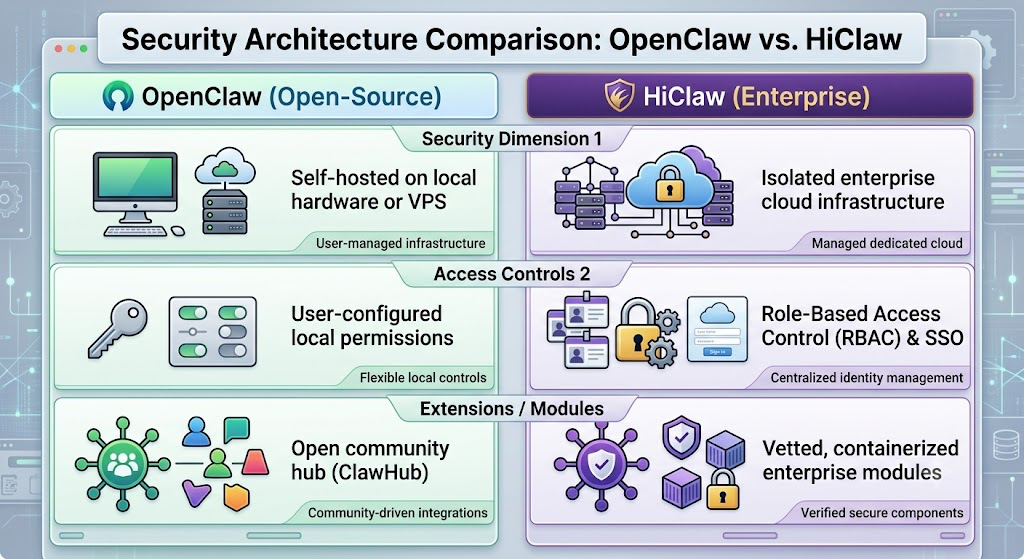
Choosing an autonomous AI agent framework comes down to a balance between open-source flexibility and enterprise security. Projects like OpenClaw (formerly Clawdbot and Moltbot) offer rapid local deployment and community-driven features, while managed frameworks like HiClaw focus on enterprise access controls, data isolation, and centralized governance.
Because autonomous agents possess execution rights—such as running terminal commands, modifying files, and managing web applications—understanding their underlying security risks is essential before deployment.
Security Feature Comparison
Key Open-Source Risk Vectors
- Remote Code Execution (CVE-2026-25253): A flaw in unpatched OpenClaw builds allows attackers to execute remote commands, impacting roughly 40,000 instances exposed online without passwords.
- Prompt Injection via System Files: Background task files like HEARTBEAT.md can be manipulated by untrusted web data or emails, redirecting agent tasks to malicious external servers.
- Supply Chain Exploitation: The “ClawHavoc” campaign saw 340+ malicious add-ons uploaded to ClawHub, designed to exfiltrate local SSH keys and login tokens.
Essential Safety Steps
If deploying OpenClaw, isolate the agent inside a sandboxed container (e.g., Docker) and restrict network interfaces. For enterprise environments, HiClaw provides built-in access controls and human approval gates for high-risk system calls.
Technical Vulnerabilities in Autonomous AI Agents
OpenClaw—an open-source autonomous agent framework created by Peter Steinberger—gained rapid adoption across developer communities. However, because autonomous AI tools execute direct operating system commands rather than merely generating text, unmanaged deployments introduce severe security risks.
Core Security Risks
- Unsecured Public Interfaces: Scans identified approximately 40,000 OpenClaw instances exposed directly to the public internet without basic password protection, allowing external users to issue commands via web browsers.
- Remote Code Execution (CVE-2026-25253): A critical vulnerability enables remote attackers to execute arbitrary code on the host machine, granting full administrative control over the operating system.
- Prompt Injection via System Files: Attackers manipulate agents using hidden instructions in emails or web pages. These instructions trick the agent into rewriting local files—such as HEARTBEAT.md—to run persistent background commands.
- Marketplace Supply Chain Attacks: During the “ClawHavoc” incident, threat actors uploaded over 300 malicious add-ons (“skills”) to the ClawHub marketplace, designed to steal saved passwords and local SSH keys.
Key Takeaways:
- Autonomous AI agents require system permissions beyond traditional chatbot interfaces.
- Unverified third-party add-ons present direct software supply chain risks.
- Unpatched vulnerabilities allow remote attackers to bypass traditional network defenses.
Shadow AI: Unregulated Hardware in Corporate Networks
Employees increasingly deploy personal hardware—such as desktop computers or micro-servers—inside office networks to run continuous AI workflows without IT oversight. This practice expands the corporate threat surface beyond unapproved browser software.
Enterprise Governance Challenges
| Industry Benchmark Category | Security Posture Metric |
| Enterprise Agent Deployment | ~40% of organizations actively test or deploy AI agents. |
| Identity Management Confidence | Only 18% of security teams feel confident governing agent permissions. |
| Public Management Nodes | Thousands of active instances remain exposed online without authentication. |
When employees install unvetted agent extensions to automate everyday tasks, they risk exposing corporate communication channels (such as Slack or Discord) to unauthorized external access. To address this exposure, organizations are adopting Agentic Posture Management (APM) to discover unmapped local runtimes and restrict unauthorized outbound connections.
Security Best Practices for Deploying AI Agents
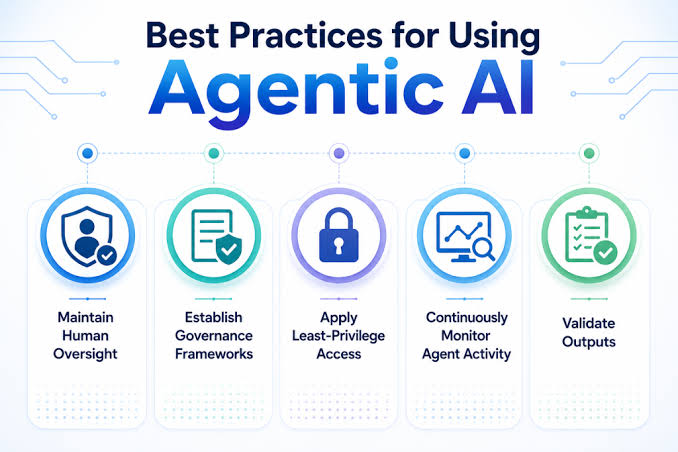
Deploying autonomous agents safely requires treating agentic software as non-human identities bound by least-privilege access rules.
1. Apply Least-Privilege Identity Controls
Limit the agent’s system permissions. If an agent only manages calendar events, revoke its ability to edit system files, execute shell scripts, or delete databases. Running agents under root or administrator accounts significantly increases breach impact.
2. Isolate Runtimes in Containers
Always run autonomous agents inside isolated environments, such as Docker containers or virtual machines. Sandboxing limits file system access and prevents vulnerabilities like CVE-2026-25253 from impacting host operating systems.
3. Audit Third-Party Extensions
Inspect all code and manifest before installing add-ons from public registries. Disable automated extension updates to prevent supply chain compromises.
4. Require Human-in-the-Loop (HITL) Approvals
Enforce manual confirmation prompts before an agent carries out high-risk actions, including financial transactions, password resets, file deletions, or mass email distribution.
Simple Security Checklist
- Lock Network Binding: Restrict control interfaces to loopback addresses (127.0.0.1) or private VPN overlays. Never leave interfaces unauthenticated.
- Isolate Execution: Run agent software in read-only container environments with strict network egress controls.
- Audit Extension Manifests: Verify the source code of all third-party extensions prior to local installation.
- Enforce Human Approval Gates: Require manual administrative confirmation for all sensitive system calls or external communications.
- Apply Security Patches: Regularly update agent frameworks to remediate known remote code execution flaws.

The Verdict: Balancing AI Productivity with System Security
Is saving a few hours of admin work worth handing over the keys to your entire network? It is a question every tech lead has to face right now. OpenClaw exploded onto the scene with over 180,000 GitHub stars, but that popularity masked some terrifying gaps. We are seeing a massive disconnect where 40% of companies have these agents running in production, yet less than a fifth actually trust their security systems to manage them. It is like hiring a brilliant intern and giving them a master key to the building before even checking their ID.
The next few months are a make-or-break period for AI agent maturity. We have already seen what happens when things go wrong, like the ClawHavoc incident where hundreds of malicious skills were pumped into the ecosystem. Unlike a standard chatbot, these agents have hands – they can write files, run commands, and talk to your Slack. When you realize 40,000 instances were recently found sitting wide open on the internet, the warning from experts like Kevin Breen hits home: the productivity boost just is not worth a total system compromise.
So, what is the right path for your team? If you cannot see it, you cannot secure it. Before jumping into OpenClaw or any autonomous tool, you need to treat these agents as high-risk identities, not just cool software. The goal is to find a balance where efficiency does not come at the cost of your company’s safety. For now, moving slowly might be the smartest productivity hack you have.
Frequently Asked Questions
What is the main difference between OpenClaw and HiClaw?
OpenClaw is a free, open-source program that you run on your own computer or server. It offers maximum flexibility, but you are responsible for setting up security and keeping it updated. HiClaw is an enterprise-focused, managed platform designed for business teams. It includes built-in security features, user permission controls, and centralized account management out of the box.
How does a Remote Code Execution (RCE) vulnerability work in an AI agent?
Unlike traditional chatbots that only type answers, autonomous agents have permission to run system commands and edit files on your machine. In an RCE attack, a vulnerability (such as a flaw in how the software processes web data) allows a remote hacker to send hidden instructions to your agent. The agent can be tricked into writing malicious code into its own setup files—such as HEARTBEAT.md—giving the attacker background access to your computer.
Is it safe to use OpenClaw for everyday personal tasks?
It depends heavily on how it is installed. Running OpenClaw with default settings or leaving its management page open to the internet without a password creates significant security risks. If you choose to use it, always run the program inside an isolated environment (like a Docker container), keep your software updated, and avoid giving the agent administrator privileges on your primary machine.
Why did OpenClaw change its name multiple times?
The project originally launched under names like Clawdbot and Moltbot before settling on OpenClaw. These changes were made to resolve trademark overlap with other tech brands (such as Anthropic’s Claude) and to establish a distinct identity as the project gained rapid popularity on GitHub.
Conclusion: Evaluating Control vs. Managed Security
The comparison between OpenClaw and HiClaw highlights a fundamental trade-off in modern AI deployment: open-source autonomy versus centralized enterprise security. While OpenClaw offers complete customization, self-managed deployments require active maintenance to defend against supply chain risks like ClawHavoc and unpatched system vulnerabilities.
As AI agents transition from passive text generators to active tools with system-level access, permission management becomes critical. Moving forward safely requires treating AI agents as privileged digital identities—enforcing least-privilege access, sandboxing execution environments, and maintaining human oversight over critical system calls. Taking a structured, security-first approach ensures you capture the productivity benefits of agentic automation without compromising network integrity.
Related Post