
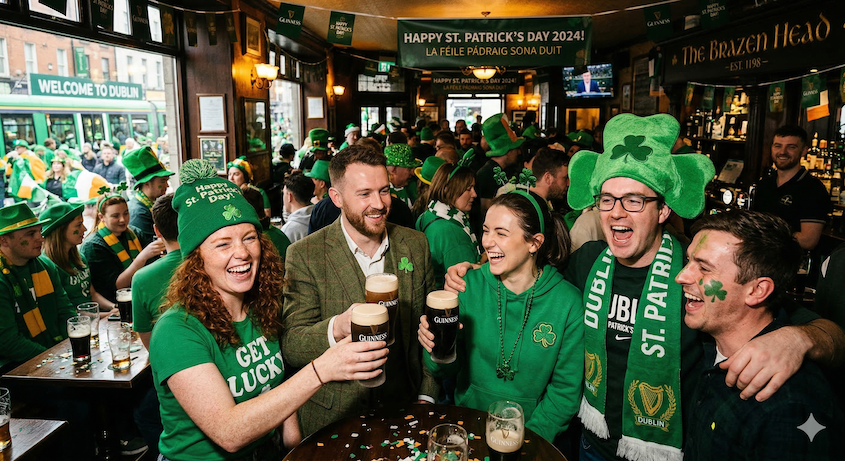
Every March 17, people all over the world suddenly own something green. Green shirts. Green hats. Green drinks. But St. Patrick’s Day is a lot older — and a lot more interesting — than a bar crawl. Here’s what’s really going on with this holiday.
Who Was St. Patrick, Actually?
Here’s something most people don’t know: St. Patrick wasn’t even Irish. He was born in Britain — probably around 385 AD — and as a teenager, he was kidnapped by Irish pirates and taken to Ireland as a slave. He spent six years there tending sheep before he escaped and made his way home.
After that, he trained as a priest and went back to Ireland on purpose. That part always surprises people. He spent the rest of his life spreading Christianity throughout the country, and when he died on March 17, 461 AD, he was already seen as a hero by the Irish people.
The story about Patrick driving all the snakes out of Ireland? Scientists say there were never any snakes in Ireland to begin with, thanks to the Ice Age. The “snakes” were likely a symbol for paganism — not actual reptiles.
He became Ireland’s patron saint, and for centuries, March 17 was a quiet, religious day in Ireland. No parades. No green beer. Just church and maybe a small family meal.
The Traditions That Stuck Around
So how did we get from a quiet religious feast day to green rivers and shamrock shakes? That’s mostly an American story.
When millions of Irish immigrants arrived in the U.S. during the 1800s — especially after the Great Famine of the 1840s — they were far from home and facing a lot of discrimination. St. Patrick’s Day became a way to show pride. The first American St. Patrick’s Day parade wasn’t in Ireland — it was in New York City, back in 1762, thrown by Irish soldiers in the British army.
The shamrock became one of the holiday’s biggest symbols because Patrick supposedly used a three-leaf clover to explain the concept of the Holy Trinity. As for the color green? Ireland has long been called the “Emerald Isle” because of its lush green landscape. Green also became tied to Irish nationalism in the 1800s.
Fun fact: before green became the go-to color, St. Patrick was actually associated with blue. You can still find this “St. Patrick’s Blue” in older Irish flags and coats of arms.
Corned beef and cabbage? That’s another American twist. Back in Ireland, pork and bacon were more common. Irish immigrants in New York discovered corned beef through their Jewish neighbors, who sold it cheap at local delis. The dish stuck, and now it’s considered a St. Patrick’s Day classic — even though most people in Ireland still find it a bit odd.
How the World Celebrates Today
St. Patrick’s Day is now celebrated in more countries than almost any other national holiday. Ireland, the U.S., Canada, Australia, the UK, Argentina — even Japan and South Korea hold events. Chicago famously dyes its river green every year, a tradition that started in 1962 when a plumber used green dye to trace pollutants. Someone got a great idea.
In Ireland itself, the holiday has actually come full circle. For decades, Irish pubs were legally required to close on March 17. That changed in 1970, and since then, Ireland has leaned into the global celebrations. Dublin’s parade now draws over half a million people.
What’s worth noticing is how the holiday means different things to different people. For some, it’s a deeply personal connection to Irish heritage and family history. For others, it’s just a fun excuse to wear green and go out with friends. Both are fine. The holiday has always been flexible — shaped by whoever was celebrating it and wherever they happened to be.
Whether you’re Irish, part-Irish, or just love a good excuse to eat soda bread, March 17 has room for you. That’s kind of the whole point.
Quick Recap
- St. Patrick was British, not Irish — he was brought to Ireland as a slave before becoming its most beloved saint.
- The holiday started as a quiet religious feast day in Ireland; it became a big public celebration largely through Irish-American immigrants.
- Green, shamrocks, and corned beef all have specific origins — none of them are as old as the holiday itself.
- Today, St. Patrick’s Day is celebrated worldwide and means something different depending on who you ask — which is exactly why it keeps growing.





Leave a Reply